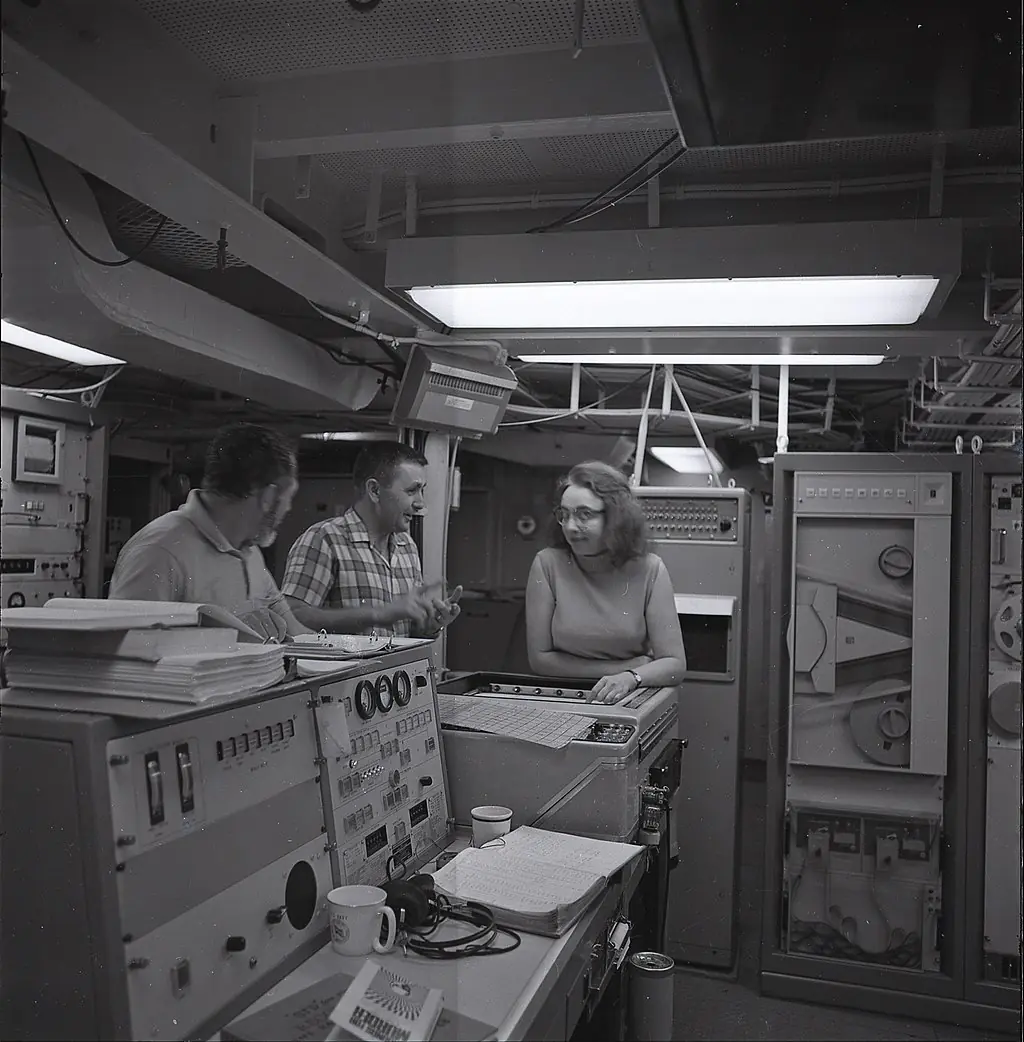
In the 1940s, Marie Tharp entered the male-dominated field of geology as a quiet yet unstoppable force, armed with brilliance, patience, and precision. At a time when women were barred from joining research vessels, Tharp took on a monumental task that would redefine our understanding of the Earth: mapping the ocean floor, line by painstaking line. While her male colleagues sailed the seas collecting data, she remained on land, meticulously translating raw sonar readings into detailed maps that revealed secrets no one had ever seen before. Her groundbreaking work not only uncovered the hidden landscapes of the seafloor but also provided the missing evidence for continental drift, forever changing the course of science.
As Tharp charted the floor of the Atlantic Ocean, she discovered something extraordinary—a vast underwater mountain range with a deep rift valley running through its center. This was the Mid-Atlantic Ridge, and its rift valley was the critical proof needed to validate the theory of continental drift, which had long been ridiculed by the scientific community. When she first presented her findings, her colleague dismissed them as “girl talk,” reflecting the era’s pervasive gender bias. But Tharp’s maps spoke louder than skepticism. They vividly illustrated the movement of the Earth’s tectonic plates, laying the foundation for the modern science of plate tectonics and confirming that the Earth is a dynamic, living planet.
Despite her groundbreaking contributions, Tharp didn’t receive immediate recognition. Her name was often omitted from published papers, and her role was overshadowed by her male counterparts. Yet, she persisted, continuing to draw and map with unwavering dedication. Over time, the scientific community caught up, and her work gained the acclaim it deserved. Tharp’s maps not only revealed the seafloor’s hidden landscapes but also reshaped our understanding of how continents shift and oceans form, proving that the Earth’s surface is in constant motion.
I can imagine Tharp hunched over her desk, her steady hands tracing the contours of the ocean floor, knowing she was uncovering truths that would outlast the doubts of her critics. Shared by its keeper, this story isn’t just about geology—it’s a testament to the power of perseverance and the impact of women in science, even when they’re forced to work behind the scenes. Marie Tharp, a woman barred from the voyage, ended up steering the course of scientific discovery, showing the world that brilliance knows no boundaries.
Tharp’s legacy continues to inspire, reminding us of the importance of recognizing unsung heroes in science and the critical role women have played in advancing human knowledge. Her story encourages us to challenge barriers, pursue truth, and honor those who quietly change the world, one map at a time.