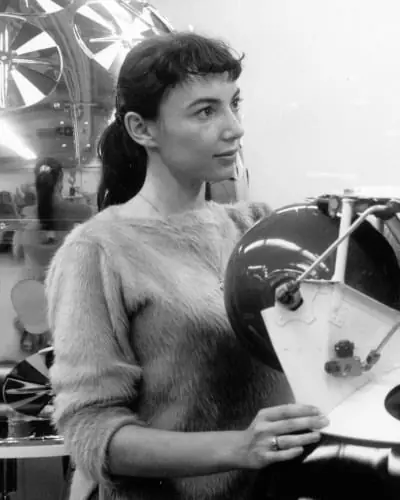
While many are familiar with the dramatic Apollo 13 mission through the Tom Hanks-led film, few know the remarkable story of Judith Love Cohen, a brilliant engineer who played a pivotal role in ensuring the astronauts’ safe return—and who also happened to be the mother of actor Jack Black. On April 17, 1970, the Apollo 13 crew landed safely back on Earth, a feat made possible in part by Cohen’s groundbreaking work on the Abort-Guidance System (AGS), a backup navigation system that became their lifeline. Her story is one of dedication, ingenuity, and a lifelong commitment to empowering others, leaving a legacy far beyond the stars.
Born in Brooklyn in 1933, Judith Love Cohen was a woman of many talents. She majored in math at Brooklyn College while also dancing for the Metropolitan Opera Ballet, showcasing her diverse passions. However, her love for problem-solving led her to engineering, earning her bachelor’s and master’s degrees from the University of Southern California by 1962. Cohen began her career in 1952 at North American Aviation and later joined Space Technology Laboratories (now TRW) in 1957, where she worked until her retirement in 1990. Her dedication was unparalleled—while in labor with her son Jack Black in 1969, she continued solving a complex schematic issue from her hospital bed, calling her team afterward to share the solution and casually mentioning, “Oh, and by the way, it’s a boy.”
Cohen’s most significant contribution came as part of the engineering team that developed the Abort-Guidance System (AGS) for the Apollo Lunar Module (LM). Designed as a backup navigation system for emergencies, the AGS was critical when disaster struck Apollo 13. The Lunar Module, meant to ferry astronauts James Lovell and Fred Haise to the moon and back to lunar orbit, became a lifeboat after an explosion damaged the Service Module. With limited water and electricity, the Primary Guidance and Navigation System was too resource-intensive to use. The AGS, which Cohen helped design, guided the spacecraft through most of its journey home, including two critical course corrections. As depicted in the film, an incorrect re-entry angle could have been catastrophic—too shallow, and the spacecraft would bounce off Earth’s atmosphere into deep space; too steep, and the crew would burn up. Thanks to Cohen’s work, the astronauts avoided both fates, landing safely on April 17, 1970.
Beyond her contributions to space exploration, Cohen’s legacy continued to grow after her retirement. She founded a children’s book company that published over 20 titles, focusing on promoting science careers for girls and advocating for environmental protection. Her son, Neil Siegel, also an engineer, noted in her obituary that she considered her work on the Apollo program the highlight of her career. Cohen passed away in 2016 at 82, leaving behind a profound impact as both an engineer and an advocate for education and equality.
Shared by its keeper, Judith Love Cohen’s story is a testament to the unsung heroes behind historic missions like Apollo 13. Her brilliance ensured the astronauts’ survival, while her later work inspired future generations, particularly young girls, to pursue STEM careers. I can imagine Cohen watching the Apollo 13 splashdown on TV, a quiet pride in her heart, knowing her engineering saved lives that day. Her life reminds us of the power of perseverance, the importance of backup plans, and the lasting impact of empowering others.