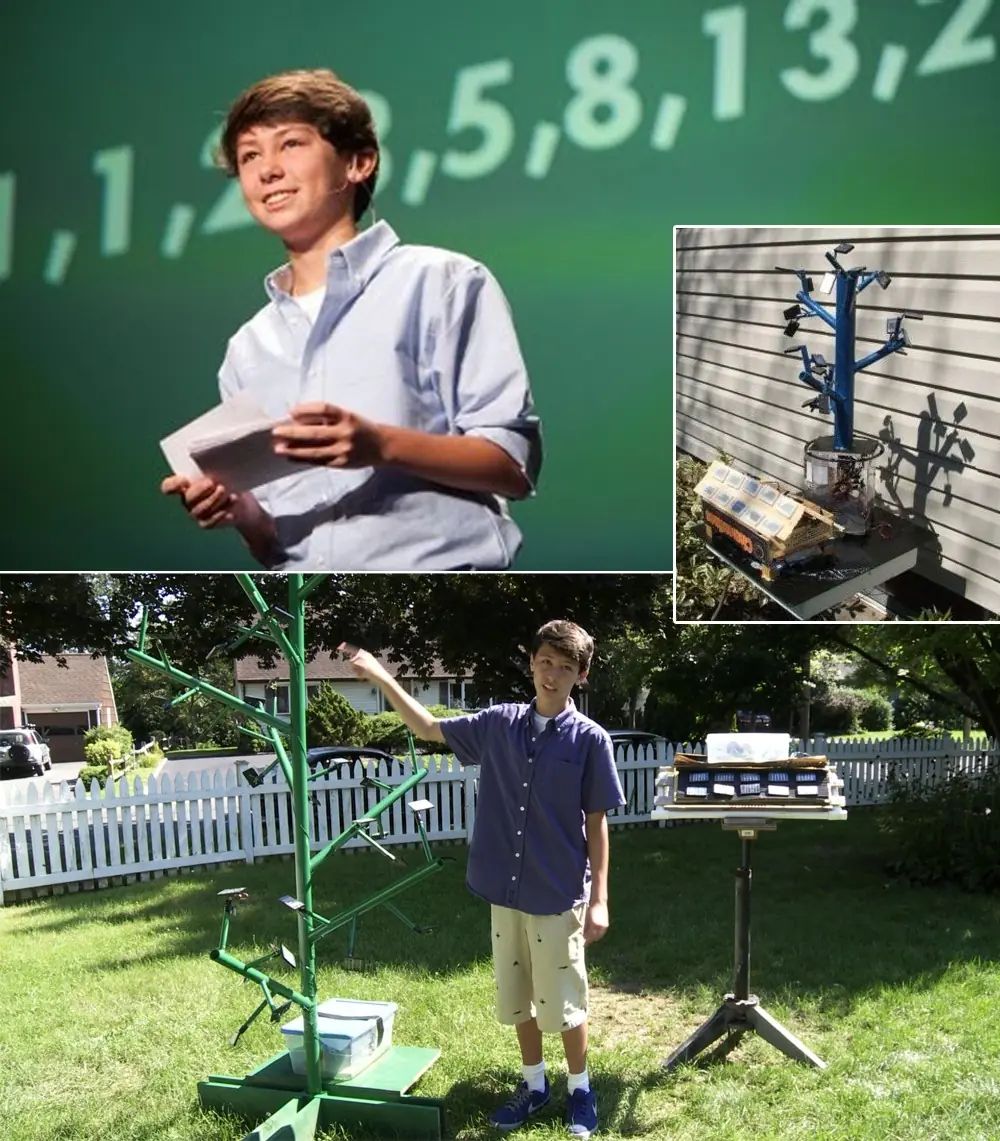
At just 13 years old, Aidan Dwyer from Long Island, USA, looked at the trees around him and saw more than branches and leaves—he saw a blueprint for revolutionizing solar energy. While hiking one day, Aidan noticed something remarkable: the spiral arrangement of tree branches followed the Fibonacci sequence, a mathematical pattern that optimizes sunlight capture, even in dense forests. This simple observation sparked a groundbreaking idea that would capture the world’s attention and earn him recognition as a young innovator with a vision for a sustainable future.
Inspired by nature’s design, Aidan, with help from his grandfather, set out to create a unique solar panel modeled after a tree. Using PVC pipes and small solar cells, he constructed a tree-shaped solar array in his backyard, designed to mimic the way branches grow in a spiral to maximize light exposure. Unlike traditional flat solar panels, Aidan’s model was built to capture sunlight more efficiently, especially in urban areas with limited space or partial shade. While his experiment focused on sunlight capture rather than electricity production, the results were promising, suggesting a new approach to renewable energy that could make solar power more accessible and effective.
Aidan’s creativity didn’t go unnoticed. His innovative project earned him a Young Naturalist Award from the American Museum of Natural History, a prestigious honor for young scientists. He was also invited to speak at PopTech, a renowned conference for innovators and changemakers, where he shared his vision with a global audience. I can imagine Aidan standing confidently on stage, explaining how a walk in the woods led to a discovery that could reshape how we harness solar energy, his enthusiasm inspiring others to look to nature for solutions. His story went viral, featured in publications like Wired and Popular Science, and became a teaching tool in classrooms worldwide, encouraging students to observe, question, and innovate.
Shared by its keeper, Aidan Dwyer’s journey is more than a tale of a clever invention—it’s a powerful reminder that nature holds profound answers if we’re willing to watch, wonder, and learn. His solar tree concept highlights the potential of biomimicry in solving modern challenges, showing that even a teenager can make a meaningful impact on the world. The next time you pass a tree, take a moment to appreciate its quiet brilliance—it might just inspire the next big idea, just as it did for Aidan.