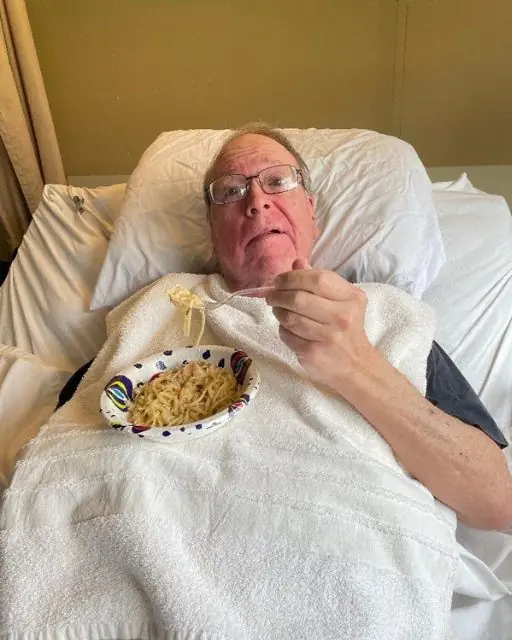
 For weeks, the food on his plate was little more than a silent witness to the slow fading of a life. My Uncle Jim barely touched his meals; the sparkle of appetite that once filled his eyes was now replaced by exhau$tion and the heavy shadows of time’s final approach. His body had become a fragile vessel, a thin thread barely holding together memories and breath. We all knew it was coming, yet nothing prepares you for the moment when the inevitable arrives.
Then, on a day I can never forget, something shifted in him. It was subtle at first—an almost imperceptible change in the tone of his voice, a flicker of clarity in his tired eyes. Sitting upright in his chair, draped with the faded towel he always wore after his baths, he looked at me with unexpected focus and said, “Tuna casserole.” His voice, usually barely a whisper, now held the unmistakable strength of remembrance.
“The one your mom used to make,” he continued, “with the crispy little onions on top.”
In that moment, the room felt charged with something deeper than just hunger. It was as if he had been waiting for this one request, saving it for the right moment. I could see it in his eyes—the light of the past flickering through the pain, the comfort of familiarity breaking through the harsh reality.
I nodded, swallowing the lump in my throat. That casserole wasn’t just food; it was a bridge across time, a thread tying us to happier days, to memories that refused to fade.
I prepared it carefully, just like I remembered: creamy, golden with bubbling cheese, topped with those crunchy fried onions that made the whole dish sing. I served it in a simple paper bowl, the same kind we used to eat from when I was a kid, sitting cross-legged on the kitchen floor.
When I placed the bowl in front of him, I saw something I hadn’t seen for weeks—a smile. Not a full smile, but a glow, a spark that nearly erased the pain that weighed on his gaunt face. He took the bowl in his hands, the skin thin and fragile, trembling slightly. Sitting at the edge of the bed, he took his first bite slowly, deliberately, as if each mouthful was a farewell, a final savoring of something precious.
We sat quietly as he ate, the soft sounds of his chewing filling the room like a fragile symphony. For a moment, it felt like the uncle I had always known—the storyteller, the joker, the man who had taught me to fish and fix a car—had returned, if only for a little while.
But halfway through, he stopped. He set the bowl down gently and looked at me, eyes shining with a gravity I hadn’t seen before.
“I need you to do something,” he said, his voice steady, stronger than I’d heard in a long time.
I nodded, leaning in closer, hanging on every word.
“When I’m gone,” he continued, “go up to the attic. Behind the old closet, pull up the third floorboard from the left.”
His hands gripped mine, the veins standing out like a roadmap of all the years he’d carried his secrets. “Promise me you’ll do it.”
I swallowed hard, heart pounding. The weight of those words settled over me like a storm. “I promise,” I whispered, barely able to speak.
He gave a tired smile, the kind that spoke of acceptance and trust. “That’s all. I think I’m done with the casserole now.”
That night, I sat with him, holding his hand as the steady rhythm of his breath slowed, and the house grew quiet with the heaviness of impending loss.
The next morning, the silence was complete. Uncle Jim had passed peacefully in his sleep, exactly as he wished.
Grief engulfed me, but his final request echoed in my mind, an unfinished story waiting to be revealed. I felt an urgency—a responsibility—to follow through.
Days later, alone in the house that held a lifetime of memories, I climbed the creaky attic stairs. Dust hung in the air like ghosts of the past, swirling with forgotten stories. The old closet was just as I remembered, a relic from childhood summers and family gatherings long gone.
Kneeling, I pried up the third floorboard from the left. The wood groaned, reluctant to give way after decades. Beneath it lay a small, weathered box, worn with age and time.
My hands trembled as I opened it, revealing fragile, yellowed letters tied with faded string. Atop the bundle was an envelope, addressed to me in Uncle Jim’s familiar handwriting.
I unfolded the letter, the paper crackling softly, a voice from the past speaking directly to me.
“To my sweet niece,
If you are reading this, I have already left this world behind. There are truths I’ve held close, things I never told you—not because I wanted to keep secrets, but because I wanted to protect you. Now, it is time you knew.”
The letter poured out stories I had never imagined. Uncle Jim had lived a life hidden beneath the surface of our family’s calm exterior. He spoke of choices that haunted him, mistakes that rippled through years, and a burden of guilt that weighed heavy on his soul.
Years ago, he had been involved in a decision—a deal gone wrong—that had caused pain to people he loved. He had tried to rebuild, to make amends, but the shadows of that past never fully lifted.
His letter wasn’t just a confession—it was a passing of the torch. A plea for understanding and a call to action.
“You will find money,” he wrote, “hidden away. An inheritance you never expected. Use it not to chase wealth, but to build, to heal, to create something good from the mistakes I couldn’t undo.”
I sat back, the letter heavy in my hands, the weight of his legacy pressing down on me. It was more than just money—it was redemption, a chance to rewrite the story.
For days, I wrestled with the revelation. I spoke to my mother, who admitted the past had been painful, too much for all of us to face at once. She had tried to shield me, to let me live without the weight of Uncle Jim’s mistakes.
Finally, I reached out to the places he mentioned. I found the account, the money secured under a name that felt like a promise—Liberty Trust.
When I first saw the figure, I was overwhelmed. It was enough to change everything—for me, for my family, for the future.
I didn’t waste time. I paid off debts, helped my family, and then invested in the community. Scholarships, small businesses, local causes—I wanted to transform the pain into progress.
Through it all, I realized that Uncle Jim’s last meal, his final request, was more than a moment frozen in time. It was a beacon—a message that even in the darkest hours, there is hope.
The dogs, Bodie and Pickle, had been silent witnesses to this revelation. Their strange fixation on the album had been a subtle guide, leading me to uncover the truth.
Their love reminded me that even when life’s secrets come to light, the bonds of loyalty and care are what keep us grounded.
In the end, I learned this: life is full of unexpected twists, of truths waiting patiently beneath the surface. And when we face them, we find strength—not just to carry our own burdens, but to build a better tomorrow.
If you’ve ever felt overwhelmed by family secrets or the weight of the past, remember: healing is possible. Sometimes, the hardest stories are the ones that lead to the greatest growth.
And sometimes, the quietest companions—like two devoted dogs—can lead us home.
If this story touched your heart, please share it. Together, we remind each other that even through pain and mystery, love and hope endure.