There are moments in life that shape us without us realizing it, moments that remain etched in our hearts for years, even decades. For a young boy, cold and hungry, an interaction with a wealthy man in his darkest hour could have been just another cruel reality in a life already full of hardships. But 13 years later, their paths cross again in a way neither could have predicted, resulting in an unexpected act of kindness that would change both of their lives.
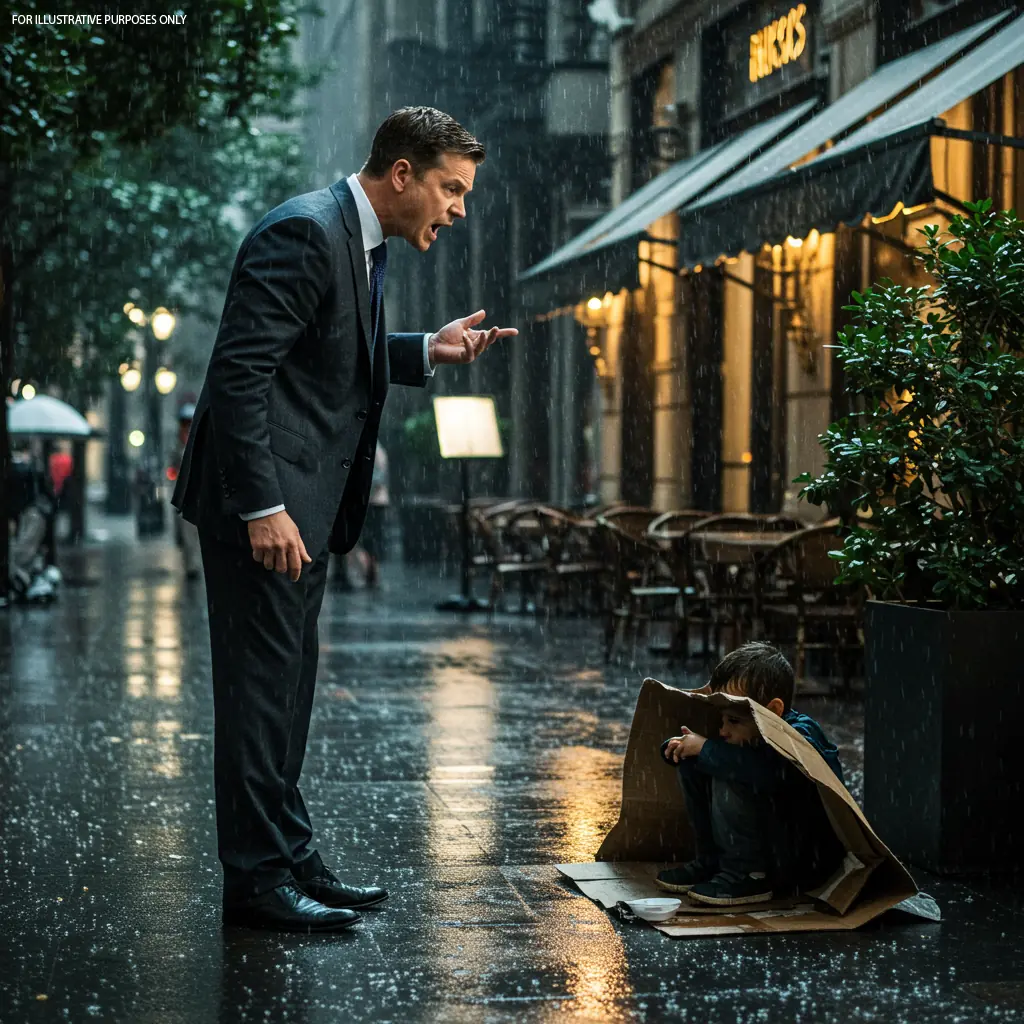
The rain was unforgiving, falling in sheets and soaking everything in its path. As I stood outside a high-end restaurant, the warmth and comfort of the diners inside mocked my misery. I was just ten years old, abandoned on the streets with nothing but a cardboard sign, pleading for help. My stomach growled with hunger, and my legs ached from standing so long in the rain. But it wasn’t just my body that hurt—it was my spirit. I was invisible, a nameless child begging for the one thing I couldn’t give myself: a meal.
The moments passed, and people passed by without a second glance. I didn’t blame them. I knew they were too busy with their lives to see me, a child in need. But then, like something out of a dream, a car appeared. It was sleek, black, polished like a mirror, and it pulled up right in front of the restaurant. I watched the man who stepped out of the car—a tall figure with silver hair, wearing a coat that looked warm and expensive. This man had the air of someone who owned the night, someone who held power and status.
The crowd moved aside as he walked toward the restaurant’s entrance. But before he disappeared inside, I found the courage to step forward. “Sir?” I asked, my voice trembling from the cold. “Please… I haven’t eaten in two days. Could you maybe help me? Even leftovers would be fine.”
The man’s gaze met mine briefly, but it was as though I wasn’t even there. He didn’t see a child. He didn’t see a human being. Instead, he saw an inconvenience, a nuisance.
“Don’t beg,” he said coldly. “Go find your parents. Get lost.”
His words stung more than the cold rain. With a dismissive glance, he walked past me, into the warmth of the restaurant. I was left alone again, shivering, feeling smaller and less significant than I ever had before.
I didn’t cry. I didn’t scream. I just stood there, frozen in place. But I didn’t forget him. I didn’t forget what it felt like to be treated as if I didn’t matter.
Years passed. Life didn’t get any easier. My mother died when I was seven, and my father disappeared a year later without a word. I ended up in foster care, shuffling from one home to another. Some homes were okay, others weren’t. But one thing remained constant—my hunger, not just for food, but for a sense of belonging, for something that felt like family.
In school, I found solace in books and quiet corners. It was there that I first found a glimmer of hope. Ms. Tully, my fifth-grade teacher, noticed something in me. One day, she sat down beside me as I worked through extra math problems during lunch. I was trying to distract myself from the gnawing hunger in my stomach.
“You’re sharp, Christopher,” she said, her voice kind and encouraging. “Ever think about college?”
At the time, the idea seemed like a distant dream. College? Me? I didn’t have the luxury of dreams. But Ms. Tully didn’t give up. She helped me apply for a scholarship, and against all odds, I got in. That was the first step, and it was a huge one.
High school brought new opportunities. I tutored other kids, I learned to code, and I built apps at night. One of those apps took off—slowly at first, but soon it exploded. I started my own company before I even graduated college. By 23, I was the youngest CEO in the state.
But no matter how successful I became, I never forgot that night. That rainy night outside the restaurant. I often wondered what I would do if I ever saw that man again, the one who had looked past me without a second thought. I knew I’d never get an apology, but I couldn’t help but imagine how I would respond if our paths ever crossed again.
And then, one day, they did.
It was an ordinary morning, one I’d experienced a hundred times before. I was at a meeting in a building made of glass and steel. My assistant had told me that the interview was for a senior finance role, a position that required years of experience. I was early, so I stood by the window, waiting, when I saw him.
It was the man. The same silver-haired man from all those years ago. He was sitting near the reception desk, clutching his resume, looking more nervous than I had ever seen him. His once-imposing presence was gone. He looked older, smaller, less certain of himself.
It took me a second to process, but once I realized it was him, my heart skipped a beat. I had to swallow the lump in my throat, but I didn’t approach him right away. Instead, I observed, unsure if he would even recognize me.
Minutes later, the receptionist called both of our names, and we stood up. I held the door open for him, and we walked into the conference room together. He sat across from me, still unaware of who I was.
I didn’t waste any time. I opened his resume and let the silence fill the space.
“You’re applying for the financial advisory position?” I asked calmly.
“Yes,” he said quickly. “I used to run my own firm. I’ve been out of the game for a while, but I’m ready to get back to it.”
I nodded, scanning his resume. “Your company folded,” I said, keeping my tone neutral. “It says here that there were mistakes. Partnerships you shouldn’t have trusted.”
He looked down, his hands shaking. “Yes. I lost everything. I just want to get back on my feet.”
I could see the weight of those words on him. And in that moment, I made the decision to ask him a question he wasn’t expecting.
“Do you remember a rainy night? Outside a restaurant?” I asked.
His eyes widened. “I… What?”
“Thirteen years ago,” I continued. “A little boy stood outside that restaurant. Hungry. Cold. Holding a cardboard sign.”
He looked confused for a moment, and then his face paled. “I… I don’t remember. But that sounds like something I might have said. I’m sorry.”
I leaned forward, my voice soft. “That boy was me.”
There was a long silence. I could see the realization hitting him, and for the first time, I saw a flicker of true remorse in his eyes.
“I was a different man then,” he said quietly. “I thought money made me better than everyone. I treated people like they didn’t matter. I’ve lost everything. I see it now. I do.”
I believed him. I could see that he was genuinely sorry, and in that moment, I felt a sense of closure.
I closed his resume. “We won’t be offering you the job,” I said gently.
He nodded, accepting the truth. “I understand.”
“But,” I added, reaching into my folder, “I know someone who runs a firm. They’re hiring. And they believe in second chances.”
I handed him my card. His hands trembled as he took it, his voice barely a whisper. “You’d do that for me?”
“I would,” I said. “Because someone once gave me a chance when they didn’t have to.”
The man left the room, standing a little straighter, a little more hopeful. I stood by the window, watching as people moved through the rain. The past seemed far away, but the lesson was clear: kindness is not weakness. It’s strength. And sometimes, the most powerful thing we can do is offer someone a chance at redemption, even when they don’t deserve it.
I don’t know what will happen to him, but I do know that I’ll always remember the hungry boy in the rain. And I’ll never stop believing in second chances.